Our personalized, holistic approach to care means that residents leave The Retreat feeling more hopeful, joyful, and healthy. And our outcomes show that our residents get better in our care.
We measure progress through clinically validated measures. See the impact of getting care at The Retreat:
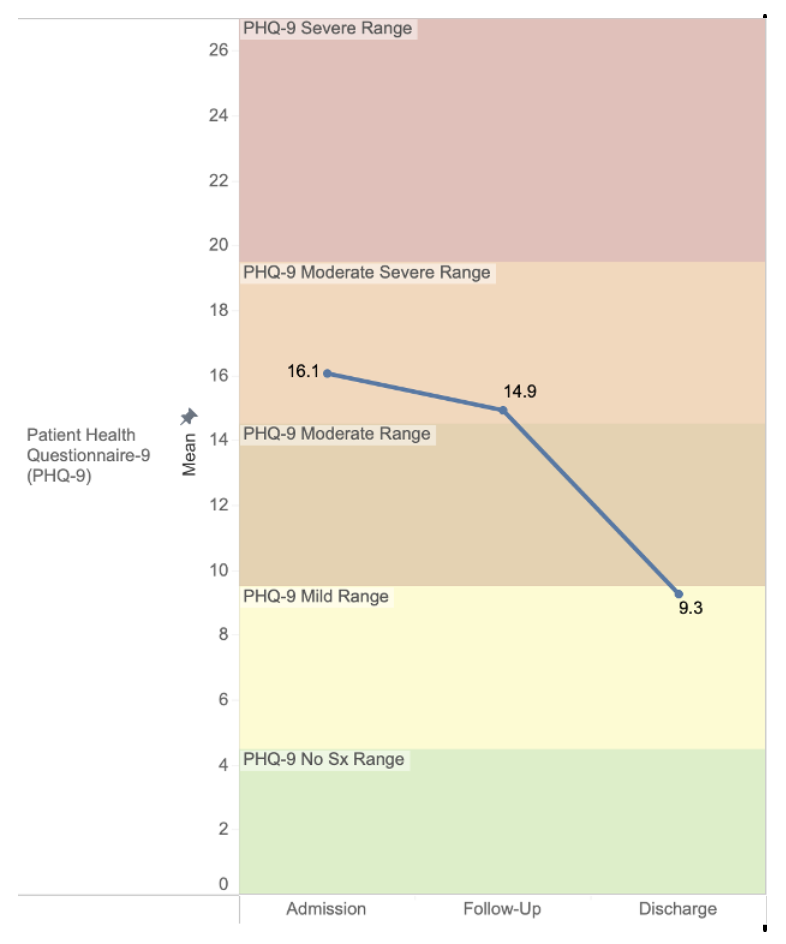
Measuring Depression: Patient Health Questionnaire (PHQ-9)
The Patient Health Questionnaire (PHQ) is a self-administered diagnostic tool for mental health conditions.
The PHQ-9 measures how severe someone’s depression is. By tracking someone’s PHQ-9 score, we can see if they are feeling less depressed using objective measures.
On average, residents come to The Retreat with their depression scoring in the “moderately severe” range. By discharge, it has dropped to a range considered “mild,” meaning our residents are leaving with significant improvement to their feelings of depression.
Measuring Obsessive-Compulsive Symptoms: Dimensional Obsessive-Compulsive Scale (DOCS)
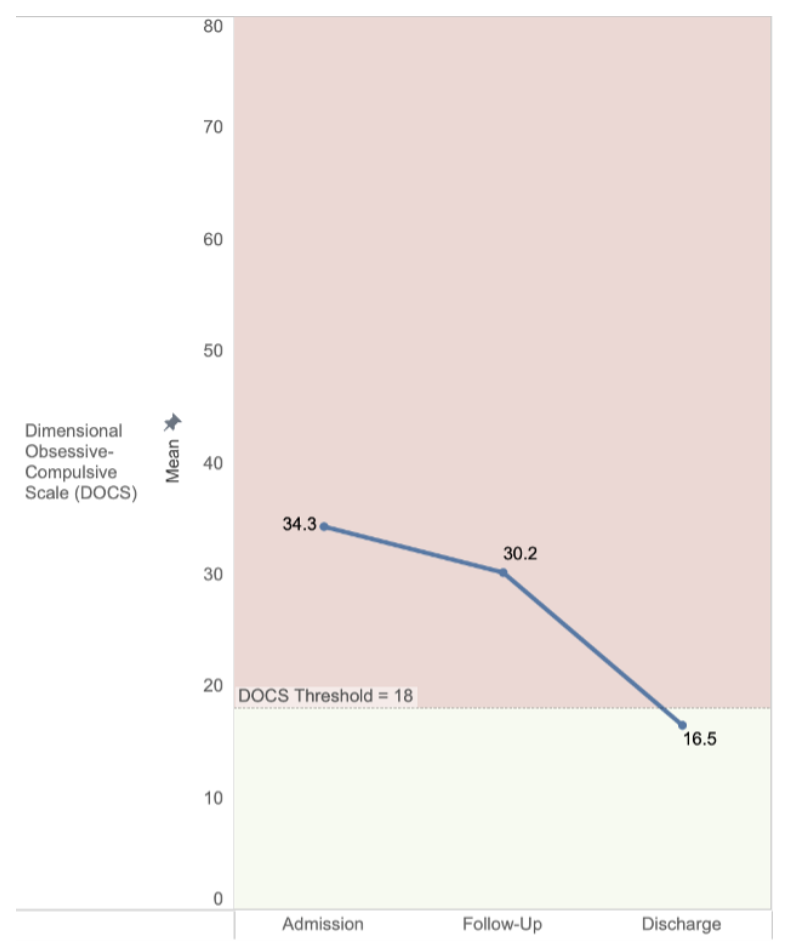
The DOCS is used to assess how severe someone’s OCD symptoms are. The higher someone’s score, the more intense and debilitating their symptoms of OCD.
Scores over 18 on this scale indicate the presence of OCD; if a score is below 18, it indicates that someone has minimal symptoms.
For residents coming to The Retreat for care for OCD, the average score at admission was 34.3. At discharge, that score plummeted to 16.5, meaning that our residents are effectively gaining mastery over their OCD symptoms.
Measuring Daily Life Functioning: World Health Organization Disability Assessment Schedule-12 (WHODAS-12)
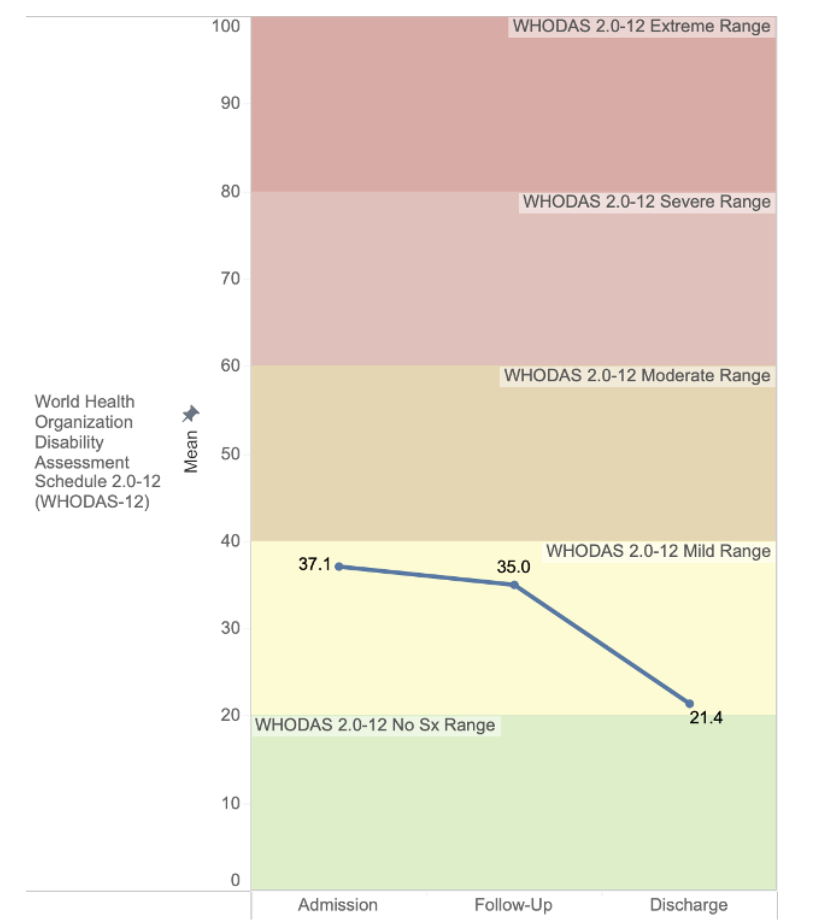
The WHODAS is a measure that assesses disability and overall functioning—how someone is functioning in their daily life and how they are participating in activities.
Through the WHODAS scale, we get an understanding of how a person is able to live their day-to-day life. Can they fulfill their roles at home, at work, and in the community?
At admission, our residents are usually at the top end of the “mild” range. At discharge, our residents are at the low end of the “mild” range—a significant improvement in their ability to actively engage in their daily lives.