Letter from Leadership
Everything we do, we do for the better. For the betterment of our patients, our students, and our communities. Here in Maryland and across the nation, we are evolving and expanding our care and services, educating the next generation of clinicians, and advancing research. We are partnering with states and agencies to fill in gaps in care to meet the needs of communities.
Transforming lives and building brighter futures is not a new initiative for Sheppard Pratt—it goes all the way back to 1853, to our core values: to meet a need, to lead, to care, to respect. For nearly two centuries, we have upheld these core values—all for the better. This is what continues to drive us today.
In this year’s annual report, you will learn about how we live out these core values—how everything we do is for the betterment of those we serve. You will read about research focused on combating early mortality in people with serious mental illness. You will see how we are expanding our anxiety and OCD services, helping thousands of people to live joyfully. You will learn about our schools, which not only provide education, but prepare students for life after graduation. You will read about our approach to caring for the whole person, bringing people the care they need, where they need it. You will learn more about our efforts to build out the mental healthcare workforce of the future. You’ll also learn about how we are disseminating best practices across the nation through Sheppard Pratt Solutions. And, you will see how Sheppard Pratt has been a steadfast partner to the state, developing innovative programs to meet the unique needs of Marylanders.
As we continue on our mission, we do so for the better. And with your support, we can achieve our vision: to be the preeminent provider of mental health services—leading innovation, and delivering compassionate, expert care when and where people need it.
Sincerely,
Joshua Kakel
Chair, Sheppard Pratt Board of Trustees
Harsh K. Trivedi, MD, MBA
President and CEO, Sheppard Pratt
Fast Facts
Changing lives, changing communities, and changing the field of mental healthcare—all for the better
Serving patients from 40 states and 16 countries
Serving nearly 80,000 individuals around the world
Largest provider of nonpublic special education schools and programs in Maryland
>5,100 employees working for patient care every day
Consistently recognized as a top national psychiatric hospital
400+ sites of service
160+ programs dedicated to compassionate patient care
Officers and Executive Staff
Harsh K. Trivedi, MD, MBA
President and Chief Executive Officer
Todd Peters, MD
Senior Vice President, Chief Medical Officer, and Chief Medical Information Officer
Kelly Savoca, CPA, MBA
Senior Vice President and Chief Financial Officer
Jennifer Weiss Wilkerson, MHSA, FACHE
Senior Vice President and Chief Strategy Officer
Paula Bostwick, RN, MSN, CENP
Vice President and Chief Nursing Officer
Jennifer Coyne, JD
General Counsel
Kathy Flannery, MEd
Vice President and Chief of Schools
Jeffrey Grossi, JD
Chief of Government Relations
Marshall D. Henson, MPP
Vice President and Chief Operating Officer, Community Services
Thomas D. Hess, MBA, MEd
Chief of Staff
Claudia E. Keenan
Vice President and Chief Development Officer
Brian Lynch, MS, SHRM-SCP
Vice President and Chief Human Resources Officer
Stephen M. Merz, MHSA, FACHE
Vice President and Chief Operating Officer, Sheppard Pratt Solutions
Bryan Mroz, RN
Vice President and Chief Operating Officer, Hospitals
Board of Trustees
Margaret Allen
Kevin M. Benson
Saralyn Elkin
Susan Fenimore
Norman Forbush
Alan Gamse
Philip H. Grantham
William Haugh
Bonita Hearn
Joshua Kakel, Chair
Alton Knight
Robert Kresslein
Cristin C. Lambros
William Morton
Patrick Miller
Collin Mothupi, Vice Chair
William Paternotte
David Saunders
Ned Walton
Jim Wiederhold
Changing the Trajectory
Tackling early mortality in serious mental illness
Individuals living with serious mental illness (SMI) die, on average, 10 to 25 years earlier than their peers. At Sheppard Pratt, this stark reality drives us to keep searching for answers and better solutions.
Faith Dickerson, PhD, MPH, senior psychologist at Sheppard Pratt and adjunct professor of psychiatry at the University of Maryland and Johns Hopkins School of Medicine, has dedicated her career to understanding why people with conditions like schizophrenia, bipolar disorder, and recurrent major depression face such shortened lifespans. Dr. Dickerson’s research, funded by the Stanley Medical Research Institute, American Foundation for Suicide Prevention, National Institute of Mental Health, and Boehringer Ingelheim, shines a crucial light on how we can help individuals with SMI live longer, healthier lives.
“People with serious mental illness die from natural causes—like heart disease or lung disease—at rates significantly higher than the general population,” explained Dr. Dickerson. “But the reasons are complex. Our work is about untangling those reasons and finding practical ways to change the trajectory.”
Through Sheppard Pratt’s innovative research program, Dr. Dickerson and her team have enrolled close to 2,500 individuals living with SMI, as well as people in a nonpsychiatric comparison group, over 25 years, gathering clinical data and biological samples. Unlike massive population registries that record diagnoses and administrative data, this research captures detailed information on individuals’ physical health, cognition, medical history, smoking habits, and even microbiome profiles.
This detailed data collection has helped the team identify several valuable insights. One key finding, published in the prestigious JAMA Network Open, identified tobacco smoking as a leading predictor of natural-cause mortality among people with schizophrenia. Although smoking is known to shorten life expectancy in the general population, its impact is magnified among those with serious mental illness, where the prevalence of tobacco smoking can exceed 50%.
“The reasons why people with schizophrenia and other serious mental illnesses smoke so much are still not fully understood,” said Dr. Dickerson. “There’s a long-standing—and incorrect—myth that smoking helps alleviate stress or improves thinking. It doesn’t. But the social environment, stigma, and historical attitudes toward smoking have made it a difficult issue to tackle.”
Other factors associated with early mortality include lower cognitive functioning, obesity, chronic medical conditions like COPD and cardiac arrhythmias, and social circumstances such as being divorced or separated. These factors create a web of vulnerability that can erode both physical health and the ability to seek and maintain medical care.
The implications of these findings are profound. As general healthcare continues to improve across the population, the mortality gap between those with and without SMI has actually widened—a reminder that mental health and physical health are intrinsically linked.
This research goes beyond theory and leads to real steps that can be taken. Dr. Dickerson strongly advocates for expanded smoking cessation efforts targeted at people with SMI. She cites previous programs at Sheppard Pratt, funded through the Maryland Department of Health, which provided brief behavioral counseling to all inpatients who smoked. “We know how to help people quit smoking,” she said. “It’s not just about telling people to stop. It requires skilled behavioral counseling and medication. But the resources have to be there.”
Beyond smoking, Dr. Dickerson hopes to see better integration of psychiatric and primary care services, reducing gaps that leave physical health needs unaddressed in people with SMI.
“We’ve seen that people with serious mental illness sometimes receive subpar medical care because their physical symptoms are too quickly dismissed as psychiatric,” she explained. “Improving collaboration and reducing stigma are critical.” This is one of the drivers of Sheppard Pratt’s Collaborative Care program in partnership with Greater Baltimore Medical Center (GBMC); Sheppard Pratt therapists are embedded in GBMC primary care offices, ensuring that mental healthcare is accessible—just a short walk down the hall.
Sheppard Pratt’s research also focuses on exploring new possibilities. Studies on probiotics, linked with a growing understanding of the microbiome, suggest they may help reduce hospital readmissions for people with acute bipolar disorder. Although more research is needed, these areas offer hope for improving both mental and physical health.
Michael Hann, MD, MBA, MS, chief of medical staff at Sheppard Pratt, highlights how this research matters in everyday life. “This work is a bridge between research and advocacy,” he said. “The insights not only inform how we care for individuals but also highlight the urgent need for policies and funding that support comprehensive, integrated care for this underserved population.”
Dr. Dickerson remains committed to continuing and expanding this work, driven by the belief that people with SMI deserve the same chance at a full, healthy life as anyone else. “It’s unacceptable that they should lose decades of life to conditions we can help manage or prevent,” said Dr. Dickerson.
At Sheppard Pratt, this research is a testament to hope and progress, and it also calls for action. Community support, partnerships, and continued investment are crucial to putting research into action to help people with serious mental illness live longer, healthier lives.
“People with serious mental illness die from natural causes—like heart disease or lung disease—at rates significantly higher than the general population. ”
Sheppard Pratt Solutions
Sharing best practices across the nation
In the wake of the COVID-19 pandemic, the country found itself facing a parallel crisis: an overwhelming and still-escalating demand for mental healthcare. According to the Centers for Disease Control and Prevention, one in five adults in the U.S. experiences mental illness each year; simultaneously, nearly 122 million Americans live in areas with too few mental health providers. More than half of the people who need treatment don’t receive it, often because there simply aren’t enough beds, programs, or professionals available. Health systems across the country were—and still are—struggling to meet this surge in need.
That’s where Sheppard Pratt Solutions steps in: partnering with organizations nationwide to embed expertise, expand capacity, and bring high-quality behavioral healthcare to communities that need it most.
Sheppard Pratt Solutions was created to fill a critical gap in behavioral healthcare nationwide. We partner directly with hospitals and health systems across the nation, as well as build new facilities to expand access, improve services, and make mental healthcare more sustainable—all while staying true to our mission of compassionate care.
“Behavioral health can’t remain on the margins of care any longer,” said Steve Merz, MHSA, FACHE, vice president and chief operating officer. “Our approach proves that mental healthcare can be financially viable, deeply integrated, and community-driven.”
Expanding the Mission, Not Just the Footprint
Sheppard Pratt Solutions brings its expertise directly to partner organizations, offering everything from short-term consulting to long-term leadership and new behavioral health programs. This flexible, sustainable model allows us to expand access to care across the country,
bringing quality care and sustainable services to people in need faster. Some systems already have behavioral health programs in place and are looking to improve operations or reduce financial losses. Others are starting from scratch.
Regardless of the setting, Sheppard Pratt, with nearly two centuries of experience, has become a trusted source for healthcare systems across the country.
According to the American Hospital Association, there are roughly 5,000 hospitals across the nation. Of those, only about 1,200 offer formal behavioral health services—such as inpatient beds or outpatient programs. And of those 1,200, approximately 900 are operated by for-profit corporations.
A Wake-Up Call in Wake County
Nowhere is the need for these solutions more urgent than in Wake County, North Carolina—an area facing significant gaps in behavioral healthcare. Home to over 500 behavioral health beds, the region is dominated by for-profit facilities. But for residents on Medicaid—or those facing complex social challenges like housing, food, or transportation insecurity—access is limited.
That’s where Sheppard Pratt’s partnership with WakeMed, a nonprofit health system in Raleigh, is changing the landscape. WakeMed’s CEO, Donald Gintzig, inspired by his own mother’s career as a psychiatric nurse, sought out Sheppard Pratt to develop the hospital’s first behavioral health program. His goal: to build a care center for patients traditionally shut out of for-profit systems.
The result is a new hospital—staffed, designed, and managed in partnership with Sheppard Pratt—that will serve those patients most in need. And unlike many behavioral health ventures that require financial subsidies, this one is designed to stand on its own.

“We don’t rely on oncology profits or MRI billing,” said Merz. “Sheppard Pratt operates entirely on behavioral health revenue. That means we know how to do this—and do it sustainably.”
Sheppard Pratt Solutions has now worked with health systems across the nation, from major players in Massachusetts to smaller, rural systems in Indiana. The model is simple but effective: Identify need, assess feasibility, and build smart, tailored services that work both clinically and financially.
That might mean placing a Sheppard Pratt executive on-site to run day-to-day operations, helping a team revamp its revenue cycle, or designing a full co-branded continuum of care for child and adolescent mental health. In all cases, the goal is the same: Create access, preserve quality, and build for the long term.
“Most systems are losing tens of millions per year on behavioral health. We show them how to cut those losses or even run services in the black. That’s a game changer,” said Merz.
Making Care More Accessible
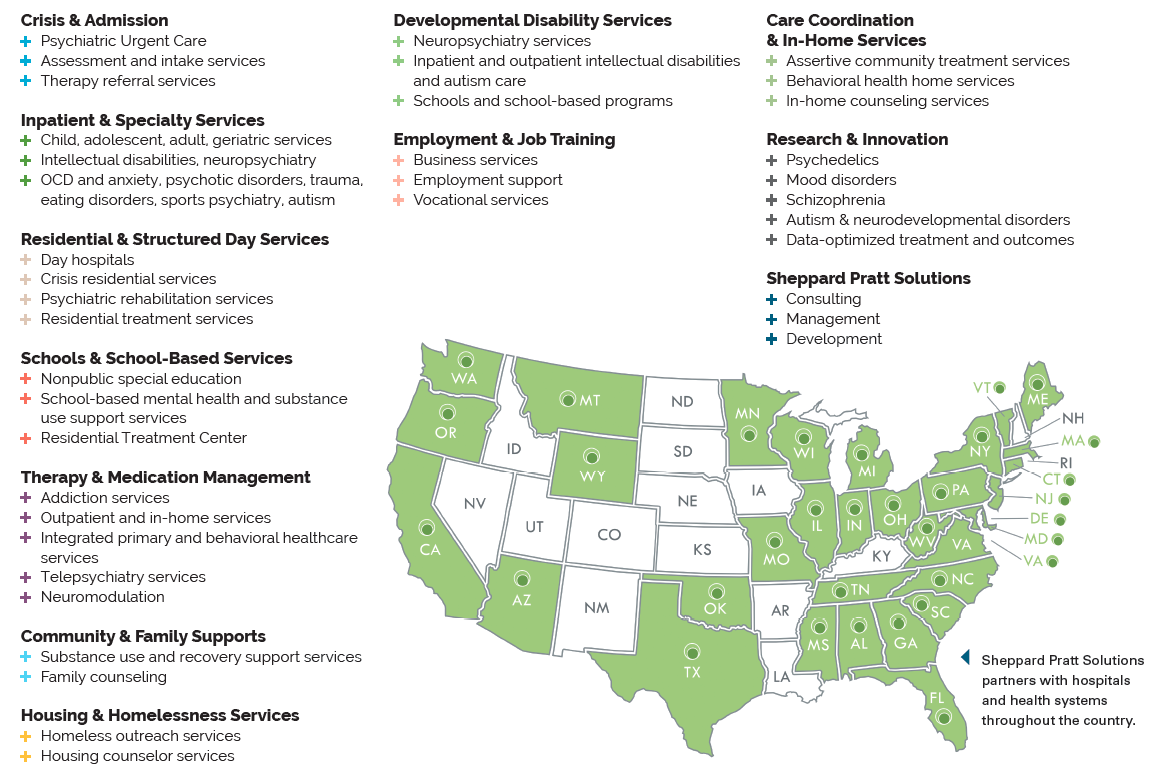
Sheppard Pratt Solutions has active projects in North Carolina, Michigan, Massachusetts, and Indiana, with several others in development, including a proposed children’s behavioral health partnership in the Southwest. Each partnership is the result of trust, transparency, and a shared commitment to better care.
What makes Sheppard Pratt different is the belief that behavioral health isn’t optional—it’s essential. By forming partnerships tailored to each community, we help health systems build strong, lasting mental health programs they couldn’t create on their own.
As Merz put it, “We don’t just drop in and offer advice. We stay, we build, and we help these systems stand on their own, because access to mental healthcare shouldn’t depend on geography or profit.”
“The niche we serve is the more difficult to treat. The more acute patient populations that other healthcare organizations shy away from, we actually lean into.”
Meeting the Needs
The growth and innovation of Sheppard Pratt’s Center for OCD and Anxiety
At Sheppard Pratt’s Center for OCD and Anxiety, commitment goes beyond clinical expertise—it’s about transforming lives. Since launching the program in 2020, Sheppard Pratt has built one of the nation’s most comprehensive and robust treatment centers for obsessive-compulsive disorder (OCD), helping individuals move beyond the paralyzing grip of “what ifs” and into lives filled with meaning and joy.
At that time, the Center for OCD and Anxiety was a modest team of three clinicians. Today, it has tripled in size, reflecting both the increased need for specialized OCD care and Sheppard Pratt’s commitment to meeting it. This expansion means that more people can access quality care faster—an essential shift in a field where misdiagnosis is common, as are delays in seeking care. On average, people wait eleven years after symptom onset before getting help. Unfortunately, for some, it can be difficult to find a provider specializing in OCD at all.
Meeting Complex Needs
In the past, people in Maryland and nearby areas often had to seek specialized OCD treatment elsewhere. To fill this gap, Sheppard Pratt built in-house services that now serve local patients and position the organization as a national leader in OCD care.
What sets Sheppard Pratt’s Center for OCD and Anxiety apart is its philosophy that no case is too complex. Many patients have multiple diagnoses—like trauma, substance use, mood disorders, or autism—that complicate OCD treatment. Thanks to the multidisciplinary team at Sheppard Pratt, patients have access to expert OCD treatment and expertise in other diagnoses, meaning they can receive holistic, comprehensive care. “At Sheppard Pratt, we don’t have to say ‘no’ to people with co-occurring issues,” Jon Hershfield, MFT, director of The Center for OCD and Anxiety, explained. “We work collaboratively, making sure we’re coming at the person with a multifaceted approach at all the right times.”
This collaborative model extends into Sheppard Pratt’s residential offerings, particularly at The Retreat by Sheppard Pratt, which integrates Hershfield’s team directly into the care environment. Their expertise has become a cornerstone of The Retreat’s programming, making it a sought-after destination for residential OCD care. Working closely with psychiatrists and other specialists, the OCD team ensures continuity of care and a highly tailored experience for each resident.
Beyond traditional cognitive behavioral therapy (CBT) and exposure with response prevention (ERP)—the gold standards for OCD treatment—the Center for OCD and Anxiety embraces a flexible, patient-centered approach. With institutional support for continuous learning, the team is empowered to pursue a variety of evidence-based modalities to meet the diverse needs of patients, including acceptance and commitment therapy (ACT), which helps individuals build psychological flexibility and resilience in the face of distressing thoughts, and radically open dialectical behavior therapy (RO-DBT), a treatment designed for individuals with perfectionistic and emotionally overcontrolled coping styles, traits often seen in OCD and obsessive-compulsive personality disorder (OCPD).
Sharing Expertise
Recognizing the need for better education in OCD treatment, Hershfield launched a monthly lecture series through Sheppard Pratt’s Center for Professional Education. This free series invites leading voices in OCD research and treatment to share insights with clinicians worldwide. The team has built a library of more than 50 talks, providing free continuing education credits online.
The Center for Professional Education also partners with the International OCD Foundation to cohost free public workshops that combine expert insights with personal stories, helping to raise awareness and reduce stigma.
Changing Lives, One Story at a Time
At the heart of Sheppard Pratt’s OCD services are stories of those whose lives have been impacted by the care they received for OCD at Sheppard Pratt. Hershfield recalls a young woman whose OCD rituals had become so consuming that she couldn’t even send a simple text message without elaborate mental routines, driven by fears that a mistake might harm someone she loved. At The Retreat, she gradually built the courage to face her fears, resist compulsions, and reconnect with life beyond OCD. Central to her treatment was using a team-based approach to help her identify her values and how OCD was getting in the way of connecting with them.
Another patient—a mother plagued by fears of harming her children—worked with Hershfield for years. Despite setbacks, she eventually found the confidence to step back from therapy, carrying forward the skills she had built to manage OCD on her own. A year later, Hershfield received a joyful email and a photo of her child, a testament to the life she reclaimed. The key was persistently applying ERP principles to daily life and working through the shame and self-stigma that held her back.
These stories illustrate The Retreat’s ultimate mission: not simply to reduce symptoms but to help people achieve mastery over their OCD and live fully. As Hershfield said, “We’re in the business of getting people back to themselves.”
The Center for OCD and Anxiety is preparing to expand its services for younger children with OCD, since research shows that 50% of cases of OCD begin in childhood or adolescence. Clinicians have already started receiving specialized training to meet this growing need.
Sheppard Pratt’s commitment to OCD care offers hope for individuals and families facing this complex condition. Through innovative treatment, collaboration, and education, the Center for OCD and Anxiety is transforming lives and ensuring no one faces OCD alone.
Driving Educational Success
Education built on a belief in every student’s potential
At Sheppard Pratt, education is about far more than textbooks and test scores. For hundreds of Maryland students with complex emotional, behavioral, intellectual, and developmental needs, Sheppard Pratt schools are where possibility begins—and futures are built—one skill, one lesson, one connection at a time.
In its special education schools across the state, Sheppard Pratt offers highly specialized programs for students whose needs surpass what traditional public schools can provide. “We do everything a traditional school does,” explained Kathy Flannery, MEd, vice president and chief of schools. “But where we are different is that we meet the needs of students where public schools cannot; we provide the holistic and mental health services they need to thrive and step in to partner with public schools.”
“We believe all students can learn. It’s a privilege to see our work change lives,” said Flannery.
Education: Taking a Holistic Approach
Sheppard Pratt’s nonpublic special education schools serve students from kindergarten through age 21, addressing a diverse range of diagnoses, including autism, emotional disabilities, multiple disabilities, other health impairments, specific learning disabilities, and speech-language impairments. Class sizes are small, averaging six to eight students, with a remarkably high staff-to-student ratio. This individualized environment enables teachers, behavioral specialists, and related service providers to deliver personalized instruction and therapeutic interventions, either in groups or one-on-one based on a student’s Individualized Education Program (IEP). These interventions impact academic progress and, more importantly, a child’s future. “That’s what really sets us apart. We’re able to intervene early and provide prevention services that can change the trajectory of a student’s future,” Flannery said.
This level of tailored support often keeps students out of more restrictive settings, like inpatient hospitalization or residential programs. The schools cultivate not only academic knowledge but also social and emotional development. Bullying rates, for instance, are significantly lower than in public schools, creating safe spaces where students can truly belong. “It’s not uncommon for us to hear a family say, ‘I’ve never had people accept my child for who they are,’” said Flannery.
Learning for Life: Beyond the Classroom
At Sheppard Pratt, education is about more than academics—it’s about preparing students for life. Through Community-Based Instruction (CBI), students build real-world skills in everyday settings. Whether grocery shopping, navigating public transit, or volunteering at local businesses, students practice independence, self-advocacy, and emotional regulation in environments beyond the classroom.
CBI also teaches workplace readiness—from understanding break times to interacting with nonschool supervisors—helping students transition successfully into adult life. For some, that path includes college. Through dual enrollment with the Community College of Baltimore County and Montgomery College, eligible students can earn credits while finishing high school. Students in Montgomery County also have the opportunity for dual enrollment at Thomas Edison High School of Technology, where they can participate in career opportunities, earn professional certifications, and get hands-on application of technical skills in several different specialized programs.
Others gain hands-on experience through internships, volunteer roles, and life-skills training in financial literacy, time management, and community safety. For students with more intensive needs, the focus is on managing routines, building leisure skills, and engaging with the world around them—safely and with confidence.
Path to Employment
Another one of Sheppard Pratt’s impactful programs is Project SEARCH, an international initiative providing immersive work experiences for students in their final year of school. Instead of spending their days in classrooms, participants go to business sites—like hospitals or hotels—where they rotate through internships, learning real job skills and building confidence.
“The ultimate goal is that every student graduates with some type of paying job,” Flannery said about the Project SEARCH program.
Beyond Project SEARCH, several Sheppard Pratt schools operate hands-on vocational programs on campus and in the community. At Sheppard Pratt School in Rockville, for instance, students manage landscaping across expansive school grounds, gaining skills in teamwork, leadership, and practical trades. “They’re learning how to work together toward a goal, how to give and receive feedback, and how to take pride in their work,” said Claire Cohen, LCSW-C, senior director of schools. “These skills can be transferred to interest-based internship opportunities at sites like the Croyden Creek Nature Center.”
Meanwhile, students at Sheppard Pratt School in Gaithersburg venture off campus to work at businesses such as the Salvation Army, Burlington Coat Factory, and Mama Lucia’s. These partnerships provide essential opportunities to practice workplace behavior, navigate public transportation, and engage in the community.
“Students who struggle in traditional academic settings can shine in other ways,” said Cohen. “They find success, confidence, and a sense of belonging.”
One shining example of this success is Marcus Moore, a proud graduate of our program and the inspiring founder of Moore Crunch. Moore, a young entrepreneur with autism from Annapolis, turned his love of pretzels into a thriving business. What began in his apartment kitchen quickly grew into a retail and farmers market success, with over 600 bags sold in just months.
Moore now hopes to expand and hire others with disabilities, proving that with support and opportunity, anything is possible. “I could hire those that are like me just to show that you can do anything,” Moore said.
The Sheppard Pratt Continuum of Care
Sheppard Pratt’s nonpublic schools don’t operate in isolation. They are part of the broader Sheppard Pratt continuum of care, giving students seamless access to specialty services, more intensive levels of care, and post-school programs when needed. “We have the luxury of being part of something bigger,” Cohen said. “If a student needs more support, we can connect them quickly.”
While Sheppard Pratt schools focus on students, the benefits reach entire families. Many students who once struggled with everyday activities now manage transitions more easily and engage in family life.
“It changes the lifestyle the family can lead,” said Flannery. “It changes relationships with siblings and extended family. The impact is enormous.” For families who once felt alone, Sheppard Pratt offers hope and real progress, making graduation a powerful celebration of how far everyone has come.
As Sheppard Pratt looks ahead, community support remains vital to keep these life-changing programs thriving. Here, education is about more than school—it’s about preparing students for a future full of possibilities.
Community-Based Instruction Partners
We team up with companies throughout Maryland to provide opportunities that prepare students for life after school. See some of our partners:
Buffalo Wild Wings
Salvation Army
Burlington Coat Factory
Sheppard Pratt Outpatient Mental Health Center
Mamma Lucia
CVS
Aspen Hill Library
Croyden Creek Nature Center
Renegade the Recycling Center
Hunt Valley Library
First Fruit Farms
The Greene Turtle
The Woodshop at Glyndon
The Hunt Valley Lutheran Church
Tom Mitchell’s Golf Complex
Baltimore County Landfill
Baltimore County Public Library
Jose Tequila’s Restaurant
Five Below
Weis Market
CVS
PCs for People
Baltimore Humane Society
FutureCare Cherrywood
Irvine Nature Center
A Progressive Path
Integrating substance use services into outpatient care
At Sheppard Pratt, progress is measured by how seamlessly we can meet the diverse needs of those we serve. In recent years, that commitment has taken shape in a new way: the integration of substance use disorder (SUD) treatment directly into our outpatient mental health centers.
Within most health systems, individuals living with both a mental health condition and substance use disorder face disconnected services, leading to gaps in treatment and barriers to recovery. But at Sheppard Pratt, this integrated approach has been critical for years. From inpatient units dedicated to co-occurring mental health and SUDs and residential programs for this patient population, we’ve led the way in coordinated care.
Recognizing the need for this comprehensive care in outpatient settings, our teams set out to transform how—and where—people access help. “It’s about meeting people where they are,” said Dana Hackey, LCSW-C, CAC-AD, clinical director of substance use services. “We tailor services to each person’s readiness and capacity, whether that means participating in a group session, attending individual therapy, or simply taking a walk with a counselor to build trust.”
A key part of Sheppard Pratt’s approach is its commitment to a harm reduction model. Instead of requiring immediate abstinence, harm reduction focuses on gradual progress.
“If someone isn’t ready to stop using, they’re not going to talk to a counselor about anything,” Hackey explained. “So we start with engagement, education, and practical support.” This compassionate approach helps people make safer choices and find their own path toward recovery, ensuring no one is turned away for not being ready to quit entirely.
Today, six of our seven outpatient centers across Maryland provide SUD services, with plans to expand further. This colocation model means individuals can receive mental health and substance use treatment under one roof, strengthening coordination and removing the burden of juggling multiple providers. As Marshall Henson, MPP, vice president and chief operating officer, community services, explained, “We are committed to a continuum of care that is responsive to the impact of substance abuse disorder on mental well-being for individuals seeking care. Integrating SUD services ensures that people seeking behavioral health support get the right care at the right level, all in one place.”
Many clients seeking care arrive with both mental health and substance use challenges—nearly 28% of our outpatient clients have co-occurring diagnoses. For some, addressing trauma is the first step; for others, harm reduction strategies pave the way toward deeper engagement. “It’s about treating the whole person, not compartmentalizing problems,” added Sandra Smith, LCPC, NCC, senior director, outpatient services. “When services are integrated, people are more likely to stay connected to care and achieve lasting recovery.”
Sheppard Pratt remains steadfast in its mission to expand access and remove barriers. This integration reflects a shared belief: that comprehensive, compassionate care should be available close to home, empowering every individual to pursue a healthier, brighter future.
Stronger Together
How Sheppard Pratt is building a better mental health workforce
As the national mental health crisis deepens, the need for highly trained psychiatrists has never been greater. With more than half of practicing psychiatrists over the age of 55, the profession faces a looming retirement problem. At the same time, demand for care continues to outpace supply, particularly in underserved and rural communities.
Unfortunately, not all residency training programs are created equal, which is especially true when it comes to psychiatry residency programs. In Maryland, Sheppard Pratt is tackling this challenge head-on.
Through its joint residency program with the University of Maryland, Sheppard Pratt is not only preparing the next generation of psychiatrists but also redefining what residency training can be. Combining academic rigor with hands-on experience, the program immerses residents and fellows in a uniquely comprehensive continuum of care—an opportunity rarely available elsewhere.
“We’re not just growing the workforce—we’re elevating it,” said Michael Hann, MD, MBA, MS, chief of medical staff. “Our graduates are entering the field not only in greater numbers but with deeper, more practical experience than many of their peers.”
Real-World Readiness
While academic medicine often leans heavily into theory and research, Sheppard Pratt emphasizes something equally essential: day-one readiness. Residents are trained to write clear, legally sound documentation, navigate interdisciplinary teams, and manage real-world workplace challenges.
“Fellows tell us they feel truly prepared to step into leadership roles,” said Vittoria DeLucia, MD, medical director, Sheppard Pratt Schools and Residential Treatment Center, who helps lead the child and adolescent fellowship program. “They’re learning how to make decisions in non-textbook situations, how to advocate for patients, and how to balance work and life in a field where burnout is very real.”
Andrew van der Vaart, MD, PhD, a former resident, credits the program’s breadth and depth for preparing him to practice independently—and confidently—on day one.
“I never felt like there was anything I was unprepared for,” he said. “Several rotations at Sheppard Pratt were key to going from observing psychiatrists to becoming one.”
Today, van der Vaart serves as the program’s associate director of residency training, helping shape the experience of new residents—proof of a training model that nurtures not only excellence but longevity and leadership.
Unmatched Clinical Breadth
What makes Sheppard Pratt’s training uniquely powerful is that it is part of one of the nation’s largest behavioral health systems, offering exposure to a wide range of specialty settings that few other programs can replicate.
Trainees rotate through inpatient units and outpatient centers, specialized neurodevelopmental programs, and day hospitals. They have access to advanced treatment options like neuromodulation, The Retreat by Sheppard Pratt, and even psychedelic therapy trials. These settings offer real-time lessons in the best practices of psychiatry and cutting-edge, novel interventions.
“Our child and adolescent fellows train in an inpatient unit for kids under 12 with autism and intellectual disabilities—one of only seven like it in North America,” said Dr. DeLucia. “We also offer experience in treating eating disorders, mood disorders, behavioral issues, and more—all within the same continuum of care.”
That continuum of care is key to Sheppard Pratt’s mission. It ensures that patients can move between levels of care—whether inpatient, residential, or outpatient—without gaps. And it gives trainees a front-row seat to integrated, holistic behavioral healthcare delivery.
Investing in the Future
Training a psychiatrist takes a minimum of four years, not including any subsequent specialty fellowships. That’s why Sheppard Pratt sees its residency program as a long-term investment in the future of mental healthcare—not just for Maryland but also for the nation.
“There’s no quick fix to the psychiatrist shortage. But we’re doing the work now to ensure that patients in five, 10, or 15 years will still have access to the care they need,” said Dr. Hann.
In doing so, Sheppard Pratt is preparing clinicians to meet the needs of today while building the infrastructure for the care every community deserves tomorrow.
“We’re constantly building the pipeline and we’re proud that many who train here choose to stay.”
Meeting the Need, No Matter What
Sheppard Pratt’s progress toward a better future
At Sheppard Pratt, doing the right thing has never been about doing what is easiest. When there is a call, Sheppard Pratt answers, stepping forward to meet the need. Since 1853, we have focused on building innovative programs that meet people where they are.
This perhaps is most evident in Sheppard Pratt’s long-standing partnerships with state agencies and local behavioral health authorities (LBHAs). These collaborations have resulted in creative solutions like Segue and the state psychiatric bed board—programs that improve outcomes and access while simultaneously reducing the overall cost burden on the state.
“When the state or an LBHA identifies a need, we ask if we can solve the problem,” offered Scott Rose, JD, chief of business development. “If the answer is yes, we get to work.”
That mindset has been a trademark of Sheppard Pratt’s leadership for decades. Take Segue, for example—a groundbreaking step-down program for individuals transitioning out of state psychiatric hospitals. Nearly 10 years ago, state leaders approached Sheppard Pratt with a challenge: Beds in state psychiatric hospitals were at capacity, and patients who were ready for discharge had nowhere to go as they navigated transitioning back to their home communities.
Sheppard Pratt developed Segue, a residential transition program designed to serve individuals with complex behavioral health needs who were not yet ready for fully independent living. Serving as a bridge between hospital and community, its impact has been significant: The average length of stay in a state hospital for these individuals had been 18 to 24 months. With Segue, that’s been cut by more than half. This model isn’t just better for patients—it’s more cost-effective for the state.
Meeting Needs Through Innovation
Sometimes, meeting the need is about thinking differently about access. That was the case in 2022 when the state tapped Sheppard Pratt to help address how many people were “stuck” in emergency departments with mental health needs.
“We were experiencing the last major wave of the COVID-19 pandemic and emergency departments were overwhelmed. Hospitals were coming to the state telling us they needed more inpatient psychiatric beds to free up space in their emergency rooms,” recalls Marshall Henson, MPP, vice president and chief operating officer, community services, who then served as director of operations for the Maryland Behavioral Health Administration. “We took a step back and thought, ‘maybe they just need to know where the available beds are.’ That’s when we brought in Sheppard Pratt.”
In a few short weeks, the Sheppard Pratt team, in collaboration with the Maryland Department of Health, developed the state psychiatric bed board: a virtual dashboard, updated daily, accompanied by a call center. The goal? To provide real-time information about bed availability. Prior to the bed board, there were, on average, 175 people stuck in an emergency room every day, waiting for the right mental health placement. Within just one month of the bed board launching, that number dropped by more than 50%.
“Sheppard Pratt was already performing this function at a system level; it made sense to partner with them to expand this system, highlighting how nimble Sheppard Pratt could be to develop something so scalable in such a short period of time,” recalled Henson.
Health system executives across the state immediately saw value in the new system. The next phase for the bed board? Showing availability across multiple levels of mental healthcare, such as residential crisis beds, to make access even easier for Marylanders.
Funding the Future
Programs like Segue and the bed board are lifelines for vulnerable individuals, and their existence depends on funding that rarely keeps pace with rising costs. “Sheppard Pratt is what a well-rounded, holistic approach looks like. People have a reason to live, a roof over their heads, a job to go to. That’s why it’s so critical that funding supports these life-changing programs,” said Jeff Grossi, JD, chief of government relations. “Roughly 70% of what we do isn’t reimbursed at the cost of care.”
More support is needed. Without sustainable funding, the ripple effects are far-reaching: increased emergency room visits, greater involvement in the criminal justice system, and higher rates of homelessness and suicide.
“Being there for the most vulnerable individuals and meeting every need is our goal,” Grossi said. “Funding for mental health needs to be prioritized so we can continue to develop innovative and impactful solutions and fill gaps.”
The Bottom Line
Through innovative state partnerships, Sheppard Pratt has built a system that transforms lives and protects the health of entire communities. But we can’t do it alone.
To sustain these vital programs, we need support from state leaders, federal partners, private foundations, and individuals like you. Together, we can ensure that help is not just available to those who most need it but sustainable for generations to come.

“Being there for the most vulnerable individuals and meeting every need is our goal.”
Letter from Philanthropy
Awestruck: That is the word I would use to describe how I feel every day at Sheppard Pratt. Each day, I witness the lives made better and prolonged by our research for people with serious mental illness. I get to learn about our commitment to disseminating best practices across the nation, equipping health systems and hospitals with the tools they need to better their communities and provide effective mental healthcare through Sheppard Pratt Solutions. I meet the next generation of psychiatrists, who are learning from top clinicians in an unparalleled environment. I see firsthand the expansion of programs like The Center for OCD and Anxiety and our outpatient mental health centers, programs that help thousands of people address their mental health in a holistic way each year. I get to attend school graduations, seeing our students leave us prepared for a meaningful, rewarding life.
Each and every day, I am awestruck to witness how we are leading the way and transforming lives to ensure we are meeting the need, no matter what.
We are fortunate to live in a time of such progress, such dedication to advancing mental healthcare for the better. This dedication has been a hallmark of the nearly two centuries of care and services Sheppard Pratt has provided, but it has never been more critical than now. Now, we can imagine the day when those living with a mental health condition can get the care they deserve.
We need your continued support as we bring that imagined day to life, as we make our vision—to be the preeminent provider of mental health services in the nation, leading innovation and delivering compassionate, expert care when and where people need it—a reality.
When you support Sheppard Pratt, you, too, can witness these incredible advances that leave me awestruck. Join us in changing mental healthcare for the better.
Sincerely,
Claudia E. Keenan
Vice President and Chief Development Officer
Fiscal Year 2025 Stats
106,318 days of compassionate, comprehensive inpatient care provided to those most in need
More than 363,000 days of around-the-clock care and support in our residential programs – a 14% increase from FY24
108,462 educational days, helping children in our special education schools learn and thrive
More than 10,348 visits to our Psychiatric Urgent Care and Mobile Crisis programs, helping people in their moment of crisis
7,500 admissions to our Towson and Baltimore/Washington hospital campuses, helping people from 40 states across the nation find hope
Partnered with hospitals and health systems in 34 states for consulting, management, and development services through Sheppard Pratt Solutions
Locations & Services
Our Donors and Partners
The 1853 Society
The 1853 Society recognizes individuals who have made the gift of a lifetime by including Sheppard Pratt in their estate plans.
Emile A. Bendit, MD
Edward Betts*
Mary E. Buchness
John E. Carnell*
Lois G. Carr*
Patricia Castillo*
Ruth Corbett*
Laura DuPont*
W. Byron Forbush II* and Elizabeth R. Forbush
Alan Garfinkle*
Lawrence R. Goldfarb*
Louise Hagar*
Nancy Kaelber
Joseph B. Kelly*
Mildred Kern*
Dora P. Kerr*
George Kostritsky*
Peter J. Lagemann*
Cristin C. Lambros
Jane C. Larson
Bernice Levinson*
Janet E. Lowman
Sonia and James Maher
Helen B. McAllister*
Douglas J. Miller
Betty J. Nash
Parsons Newman*
Nancy B. Paternotte and William L. Paternotte
Patricia A. Prugh
Ruth T. Ravenel*
Donald R. Ross, MD, and Eileen K. Steinberger, MD
Carolyn W. Sanger*
Robert and Marilyn Schaftel
Dennis and Sandra Schrader
Steven S. Sharfstein, MD and Margaret Sharfstein, MD
Kay L. Sienkilewski
Mary L. Siess*
Kate Snow*
Wilhelmina Waidner*
Jean and Gordon* Wells
Elise Wheeless
William T. Whiteley, Jr.*
Gay* and Jud Williams
Donna M. Zidwick
Mary Elizabeth Zumstein*
*Deceased
Our Donors and Partners
Our donors and partners play an important role in helping us lead the way. With your support, we will continue to meet the unmet mental health needs of our communities. Sheppard Pratt recognizes new pledges and gifts of $100 and above received between July 1, 2024 and June 30, 2025.
$1 million and above
Howard County Government
Maryland Community Health Resources Commission
The State of Maryland
Montgomery County Government
U.S. Department of Veterans Affairs
$250,000 and above
Behavioral Health System Baltimore
Kim and James C. Davis
Nancy B. Paternotte and William L. Paternotte
Women's Hospital Foundation
$100,000 and above
Bender Foundation
Maryland Department of Health
Patrick Miller and Amy Plotkin
Dennis and Sandra Schrader
$10,000 and above
Margaret Allen and Philip Perkins
Amy Bachelder
Benchmark Construction Company, Inc.
Kevin and Kimberly Benson
Mr. and Mrs. Edward H. Berge, Jr.
Brown, Goldstein & Levy, LLP
Mary Catherine Bunting
Dr. Penelope S. Cordish
Michael R. Cunningham
Eliza and David Dunn
Saralyn and Jeffrey Elkin
Frances A. Delaplaine Randall Charitable Trust
Andrew H. and Susan A. Friedman
Josh Goldsmith
Harry & Jeanette Weinberg Foundation, Inc.
Susan and Willie Howe
Benno and Elayne Hurwitz Family Foundation, Inc.
Joshua Kakel
Kassolis Family Foundation
Mead Family Foundation
PlanNet Cares Foundation, Inc.
PNC Foundation
Rogers-Wilbur Foundation, Inc.
Goldwin I. Smith, Nancy Schiffer, & Grant and Amelia Howerton
Kathy Shapiro
Gail and Stephen Shawe
Tracy and John Shirk
Robby S. Stempler
Mrs. Anne L. Stone
Bradley and Kimberly Troy
Donna M. Zidwick
Carol and Joe Zito
$5,000 and above
1925 LTD
1931 LLC
L. Earl and Mary Armiger
Baltimore Ravens
Patti Baum
Mrs. Erin Becker
The Bendit Family Foundation
Mr. and Mrs. Thomas Bozzuto
Brown Advisory
George L. Bunting
The Classic Catering People
Concor Networks, Inc.
Sam and Muffin Dell
Gallagher, Evelius & Jones, LLP
Geico Philanthropic Foundation
Diane and Robert Gingell
Beth H. Goldsmith
Phil and Jane Grantham
Hall, Render, Killian, Heath & Lyman, P.A.
Cristin C. Lambros and Matt Levinger
Lewis Contractors
MacKenzie Commercial
Marshall Craft Associates, Inc.
Charles and Elsa Maskell
Randolfe C. Metcalfe
Merritt and Adam Miller
MOI
PKF O'Connor Davies
Janet Risseeuw
Schneider Electric Buildings Critical Systems, Inc.
Skyline Technology Solutions
William and Caroline Stewart
Unlock Health
Scott and Kristin Vogel
Joni P. Werthan
Scott and Jennifer Wilson
Wright, Constable & Skeen LLP
$2,500 and above
APG Federal Credit Union
Baltimore Community Foundation
Berkeley Research Group (BRG)
S. Winfield Cain
CannonDesign
Comm-Tronics, Inc.
Dorn Electric
Susan M. Fenimore
Fidelity Investments
Brian and Kristin Finkelstein
Barbara and Alan Gamse
Guernsey Inc.
Thomas D. Hess
Ironmark, Inc.
JLL
JPMorgan Chase
Mr. and Mrs. Robert S. Killebrew
KPMG, LLP
Sandy and Andrew Levy
Wilma Maye-Eady
Collin Mothupi
Michael Murray
Peake Federal Credit Union
PMM Companies
Quest Diagnostics, Inc.
Ms. Shanaysha M. Sauls
David E. Saunders
Ron and Pam Sheff
St. Peter's Catholic Church
Alexis Thompson and Ashley Thompson
Dr. and Mrs. Harsh K. Trivedi
Edward F. Walton II and Sarah Walton
Whole Foods Market
Stephen J. Williams
$1,000 and above
Bonnie and David Allan
David and Deborah Astrove
Bob Avonda
Beth Babikow
Michelle Brandenburg
Allison Brill and Peter Kwiterovich
Colleen and Richard Bullen
The Campbell Foundation, Inc.
CareFirst BlueCross BlueShield
Marina Cecchini
The Community Foundation of Frederick County
Leslie Cumber
Harriet and Steve Dopkin
Todd and Valerie Dorn
Evan Elkin
Howard Bruce Fenwick
Elizabeth R. Forbush
Laura Gamble and Rob Gillison
Karyn and Greg Gattman
Rosanne B. Hanratty
Lindsay Hardesty
Lauren Herschman
Holtzople Heating & Air Conditioning
Michelle Hooper and Mr. John Springer
W. Tedrick Johnson
Karina's Bakery
Kim Kavanagh
Renee Knight and Alton Knight
Richard P. Koors, Jr.
Annabella and Peter Lapera
Kenneth and Carol Lew
Kim and Keith Lewis
Christopher and Michelle Little
Wayne Maddox
Eugenia Masland
Brian and Sandra Moffet
Joseph Monroe
Montgomery County Public Schools Educational Foundation
Donna and Brook Morris
Todd Peters, MD
Jacob S. Schapiro Foundation, Jane and Stan Rodbell, James R. Schapiro
Timothy M. Rommel
Rossmoor Women's Club
Mary Catherine Savage
Kelly Savoca
Scott Shane and Francie Weeks
Mr. and Mrs. James R. Shapiro
Steven S. Sharfstein, MD and Margaret Sharfstein, MD
Richard and Annabelle Sher
Claire M. Smith
Sonya Snedecor, PhD
John and Peggy Steele
Edward and Margaret Trojan
United Concordia Dental
United Way of Central Maryland
J. Ken Walters, PharmD
WebMD Ignite
Kelly and David Wenner
Jennifer W. Wilkerson
Robert L. G. Williams
A.A. Windesheim Charitable Foundation
Pamela P. Young, PhD
$500 and above
Jason Addison, MD
American Association of Directors of Child & Adolescent Psychiatry
Aya Healthcare
Crystal Barnes
Matt and Deb Baum
Bedford Road Volunteer Fire Department
Susan Bellamy
Donna and Ronald A. Blanck
Donald and Janet Boardman
Susan and Robert Bodansky
Ryan Burton
Bruce S. Campbell
The CarMax Foundation
Keith Carswell
John and Sheila Compton
Abbie L. Cornblatt
Damascus Y-Women
Christine and John Dinwoodie
Rev. Lindley G. DeGarmo and Ms. Sarah J. Finlayson
Kathleen A. Flannery
Nancy C. Gieser
David Goode
Senator Guy J. Guzzone
Kim Ha
William L. Haugh, Jr.
Daniel K. Hayes
Mari Heagerty
Bonnie Hearn
Brian Hoover
Henry and Nancy Hopkins
Elaine B. Johnson
Kevin Kyle
La Divina Pasta
Robert and Barbara Lagas
Diane Maistros
Kay Martinez
Miles & Stockbridge PC
Kimberle Morton
Lisa Mutschler
Angela Myers
Thomas Owen
Glynn I. Owens
Janet Parrish
Esther Richards
Albert and Kathy Schiffer
Dara and Charles Schnee
LaTonya D. Shedrick
Sheppard Pratt Physicians, PA
Kenneth Shin
Shelley Summerville and Kevin Summerville
Carole & Martin Taylor
Tribe Indoor Cycling, LLC
Susan and Andrew VanHorn
Drs. Samson and Meena Vimalananda
Warner Service
WMS Partners
$100 and above
Heidi Abdelhady
Ella Aiken
Cynthia Allen
Benjamin and Janelle Andrews
Gregory and Jordann Ashe
Andrea and Michael Ault
Mr. and Mrs. Joe Ault
Ms. Mary Azrael
Anne D. Bailliere
Con Baker
Amar Bakshi
Karen and George W. Benson, III
Shannon Bergeron
Devi Bhuyan
John P. Biggs
Karyn Blad
Dana Blanchard
Mr. and Mrs. Gerald Blessing
James D. Blum
Ms. Jessica Boileau
David Bolick
Gregory Bowers
Felicia Bracey
Michele L. Brill
Steve Burkhart
Delora Byrd
Darcy Cahill
Dennis B. Callegary
Maria Canchila
Scott and Erinne Canuel
Jonathan and Mollie Caplis
Catherine and Fred Cecere
Pamela Chambliss
John Chandler
Mary Lou Clagett
Judge Raymond Clevenger
Daniel Coate
Emma Collie
Joseph Collins
Giovanni Contreras
Matt and Carla Cooper
Jennifer Coyne
Susan M. Cromwell
Gregory M. Cross
Andy and Dana Dalton
Kathi Danielson
Rob Darrow
Alexandra Davis
Sarah Davison
Ms. Louise F. Delavergne
Dimensional Health Care Associates
Laurie DiRocco
Ferdinand Dorn
Stacey Duncan
Gerald Eichner
Mary Fallon
Max Fineblum
Lynn F. Flanigan
Ms. Maya Foster-Brown
Mark and Katie Foxx
Nancy Foy
Ms. Emily F. Frank
Joshua French
Tracey Friedly
Michael Gallagher
Stacey Garnett
Joy Gill
Andrew and Gretchen Gillespie
Give Lively Foundation
Cheryl Glang
Lorraine and Fitzgeral Goodridge
Sarah Grantham
Mr. Henry R. Green, III
Laurie Greene
Adam Greider
Jared & Ashley Grodnitzky
Philip Guidrey
Raymond Gull
Zhihong Guo, MD
Alice and Jerry Guppy
John Hackman
Mark and Sandy Hajjar
James M. Hannan
Mr. and Mrs. Philip M. Hannan
Derek Heckler
Christopher Hertz
Michele Hester
Tammy Heyman
Dan and Gina Hirschhorn
Elizabeth & Greg Hobelmann
Susan Holloway
Mr. and Mrs. John R. Jackson
Leah K. Jordan and Donald R. Jordan
David and Kristin Kaelber
Nancy Kaelber
Miriam E. Katowitz
Claudia Keenan
Robert and Miriam Kellaway
Kristina Knuppel
Peter Kopperman
George Korengold
George and Leanne Kreis
Raymund Lacson
Neel Lalchandani
Jim Langley
Gerry and Nancy LaPlante
Tina Lauber
Margo Lauterbach, MD
Sandra Layton
Vicki Leemon
Mrs. Eileen Leikach
Chad Lennon
Rebecca Ley
Jimmy Li
Dr. Scott D. London and Stephanie London
Valerie Lovelist
Lawrence Lubetsky
Tim Lupinacci
Dorothy B. Lyles and Amy E. Dunsmore
Amy Macht and George Grose
Thomas Maganas
Ashley Mancinelli
Julie S. Marshall
Jason Martin
Mr. Jonathan Mayer
Susan McCormick, PhD
Paige McMillan
Liz Meador
Ravi Melwani
Hagar Mensah
Charles Metcalf
Anne Meyer
Amy Meyerl
Adam Miller
Matt Miller
Sheri Miller
Julia Miner
Arialdi Minino
Mr. and Mrs. Gene Morrison
Jason Mort
Margaret Moses
Maureen Mulcahy
Howard Murray
Nelson Coleman Jewelers
Network for Good
Marissa Null
Alexander Ose
Chris Oven
Sue Parker
PayPal Giving Fund
Gail Phillips
Michael Phillips
Richard Phillipson
Shari Price
Progressive Insurance Foundation
Kristen Pruitt
Maria Purcell
Qazi M. Rahman
Andrew Rellihan
Michael Rifkin
Nicholas Riley
Mr. David Robinov
Barbara L. Robinson
Scott Robinson
Jonathan Rockman
Frank Rosato
Sharon Runkles
Jeffrey and Beatrice Russell
Alfredo Sagisi
Marilyn and Robert Schaftel
Diane Schechter
Ms. Lucille A. Schiffer
Nichelle Scott
Concetta Scotto-Sheffert
Keith R. Seeley
Mr. Anthony Settineri
Erin Sheridan
Bobby Shirk
Sonik Sikka
Mr. Nathan I. Silver
Laura Simmons-Smith
Katherine Simon
Sandra Smith
Nancy Sneed
Mr. Ira Steinberg
Edward Steinhouse
Laura Stillman
Suzanne Stillman
Briana Stringfellow
Suzanne S. Stutman
Mary L. Summerville and Donald C. Summerville
Stephen Surko
Amy Swam
Bethann Talbot
Michael Teitelbaum
Irvin Thomas
Damico Thompson
Sidney Trieger
Fred and Amey Upton
Linwood Van Horn
Celia E. Van Lenten
Ms. Autumn Van Ord
Michael Ventura
Linda J. Wallen
Walsh & Associates Insurance, Inc.
Deborah Waters
Ingrid Watson
Tara Watts
Elise Wheeless
Kathy and Brett Widenhouse
James and Penny Wiederhold
Katie Wilburn
Ryan and Nora Will
James Willard
Susan Wolfe
William Wu
Sue and Alan Young
Carol and John J. Zingo
Kelly Zingo
Tribute Gifts
The tributees listed below were honored with gifts of $100 or more between July 1, 2024 and June 30, 2025.
In Honor of Scott T. Aaronson
J. Ken Walters, PharmD
In Memory of Ray Ault
Mr. and Mrs. Joe Ault
Andrea and Michael Ault
Donna and Ronald A. Blanck
Catherine R. Cecere and Fred A. Cecere
Dorothy B. Lyles and Amy E. Dunsmore
Mary L. Summerville and Donald C. Summerville
Shelley Summerville and Kevin Summerville
Susan Vanhorn and Andrew Vanhorn
In Honor of David Kirk Barton
Joni P. Werthan
In Memory of Julian Howard Burgess
John and Mary Burbridge
In Honor of Andrew Darrow
Rob Darrow
In Memory of Anna Maria Dasbach
Emma Collie
In Memory of Nancy Diener
Brett and Kathy Widenhouse
In Honor of Alexandra Dirocco
Laurie DiRocco
In Memory of Stacy N. Dorsch
Karen O. Benson and George W. Benson, III
In Honor of Scott Van Dusen
Joni P. Werthan
In Honor of Saralyn Elkin
Sarah Davison
In Memory of Maggie Flanigan
Lynn F. Flanigan
In Memory of W. Byron Forbush
Elizabeth R. Forbush
In Memory of Martin P. Gieser
Nancy C. Gieser
In Memory of Faye Hagwood
Sue Parker
In Honor of the Sheppard Pratt Hunt Valley School
Heidi Abdelhady
In Memory of Charles Kaelber
Nancy Kaelber
In Memory of Michael Francis Kirk Hammaker
Mr. Nathan I. Silver
In Honor of McKenna J. Lauber
Tina Lauber
In Honor of Charles Levine
Michele L. Brill
In Memory of Lauren LeVine
Susan McCormick, PhD
In Memory of Margaret Catherine MacNeil
Nancy Sneed
In Honor of Julie S. Marshall
Rev. Lindley G. DeGarmo and Ms. Sarah J. Finlayson
In Memory of Bernard J. McGovern
Karen McGovern
In Memory of Sierra Mitcheltree
Deborah Waters
Mary Murray
Howard Murray
In Honor of Elizabeth Nee
Ryan and Nora Will
In Honor of William L. Paternotte
William and Caroline Stewart
In Honor of Anh Pham
Kelly Pham
In Honor of Bonnie Elizabeth Phillips
Gail Phillips
In Memory of Michael Reeves
Michelle Brandenburg
In Memory of Czarina S. Santos-Borja
Ms. Autumn Van Ord
In Honor of Deb Schechter
Diane Schechter
In Honor of Natalie Selden
Philip H. Grantham
Sarah Grantham
In Honor of Sheppard Pratt Staff
Kimberle Morton
In Memory of Alfred L. Singer
Pamela P. Young, PhD
In Memory of Michael I. Smith
Amy Bachelder
Albert and Kathy Schiffer
Ms. Lucille A. Schiffer
Nancy Schiffer and Goldwin Smith
In Memory of David Simpson Stillman
Benjamin and Janelle Andrews
Philip Guidrey
Alice and Jerry Guppy
Gerry and Nancy LaPlante
Liz Meador
Paige McMillan
Jeffrey and Beatrice Russell
Jonathan Rockman
Katherine Simon
Laura Stillman
Suzanne Stillman
In Honor of Elizabeth Thompson
Stephen Surko
In Honor of Harsh K. Trivedi
Tim Lupinacci
In Memory of Tara L. Watts
Tara Watts
In Memory of Gay Williams
Pamela P. Young, PhD
In Honor of Charlie Wissel
Walsh & Associates Insurance, Inc.
In Honor of Michael A. Young
Sue and Alan Young